Subtropical humidity and localized rainfall from Buffalo Bayou to Clear Lake foster dense breeding habitats for Culex quinquefasciatus and Aedes albopictus. Standard retail misting systems often broadcast…
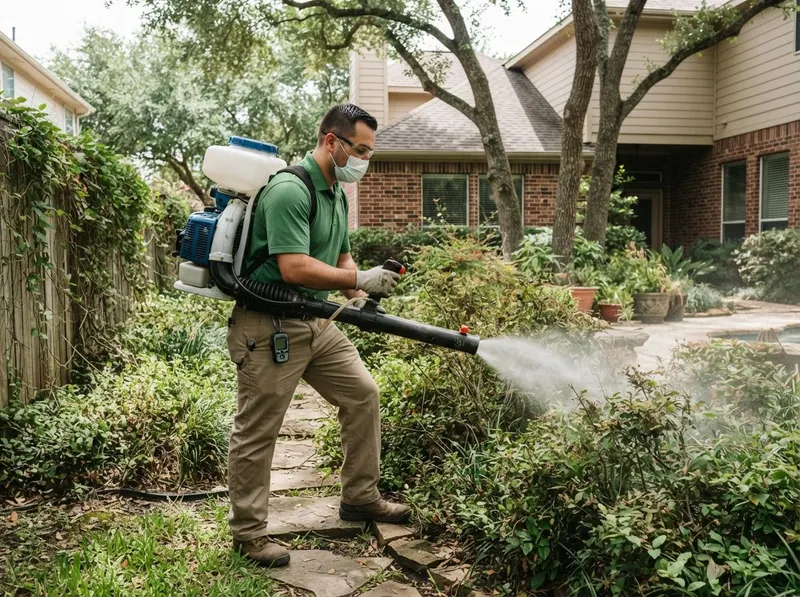
Subtropical humidity and localized rainfall from Buffalo Bayou to Clear Lake foster dense breeding habitats for Culex quinquefasciatus and Aedes albopictus. Standard retail misting systems often broadcast indiscriminately, yet professional suppression requires targeting the exact microclimates where adult mosquitoes rest during midday heat. Technicians direct treatments to the undersides of broadleaf foliage, shaded turf lines, and fence perimeters up to 10 feet high. For shaded lots in The Heights, Montrose, or River Oaks with mature oak canopies, this barrier disrupts daytime harborages. Concurrently, applications of Bacillus thuringiensis israelensis (Bti) into standing drainage water prevent larvae from pupating without affecting beneficial aquatic life, honeybees, or local songbirds.
Selecting standalone residual fogging without larvicide leaves properties vulnerable within 10 to 14 days as subterranean retention zones hatch new broods. Combining monthly larviciding with structural drainage checks provides stable, multi-week suppression across high-water properties in Meyerland or Memorial. The trade-off involves application frequency: while larvicidal treatments protect continuously inside drains and catch basins for 30 days, heavy Gulf Coast rain events exceeding 3 inches within 24 hours can dilute foliar barriers faster, necessitating scheduled monthly reapplications between March and November. Homeowners avoid indiscriminate chemical exposure by keeping pets and children off treated turf for 60 to 90 minutes until wet applications dry completely.
Implementation proceeds through four methodical stages to ensure complete yard coverage. First, technicians map standing water sources across low-lying soil lines, birdbaths, and catch basins. Second, naturally occurring bacterial larvicide tablets are placed into water features that cannot be drained manually. Third, motorized backpack misters deliver micro-encapsulated adulticide to shaded perimeter foliage, breezeways, and structural foundations. Fourth, technicians identify structural plumbing or gutter blockages holding stagnant water, providing property managers in Oak Forest and West University Place with actionable drainage corrections to keep breeding counts low.
Every job gets a firm, written price after a free on-site visit.
Tell us about your exterior mosquito suppression and larvicide application job in Houston and we'll send a clear, written quote, usually the same day.
 Bayou Hawk Pest Control