Roof rat attic exclusion and mechanical trapping delivers calm, targeted relief from arboreal rodents that exploit Houston's humid, subtropical canopy. In established neighborhoods such as The Heights, Montrose, and…
Roof rat attic exclusion and mechanical trapping delivers calm, targeted relief from arboreal rodents that exploit Houston's humid, subtropical canopy. In established neighborhoods such as The Heights, Montrose, and River Oaks, mature live oaks and pecan branches drape directly over cedar shingle and composite roofs, giving black rats elevated access points above rain gutters. Unlike ground burrowers, roof rats access attic insulation through gaps as narrow as 0.5 inches along soffit returns, ridge vents, and plumbing stacks near air conditioning chases. Mechanical trapping addresses this pressure directly inside structural spaces using precision snap stations placed along identified directional runways. This approach avoids indoor rodenticide baits, which risk foul odor and fly blooms when rodents expire inaccessible behind drywall partitions.
Selecting a pure exclusion and mechanical extraction protocol is critical when active rodent noises develop above ceilings in Meyerland, Memorial, or Oak Forest. Over-the-counter anticoagulant baits present severe secondary poisoning hazards to household pets and non-target urban raptors hunting along Buffalo Bayou. Chemical baiting also fails to stop recurring infestations because it leaves primary entry gaps intact. The structural trade-off with physical exclusion is that it demands careful exterior carpentry: sealing roof-fascia junctions with 23-gauge galvanized wire mesh and elastomeric sealants requires physical exterior ladder work, whereas trapping requires monitored attic visits every 3 to 5 days until complete population clearance is achieved.
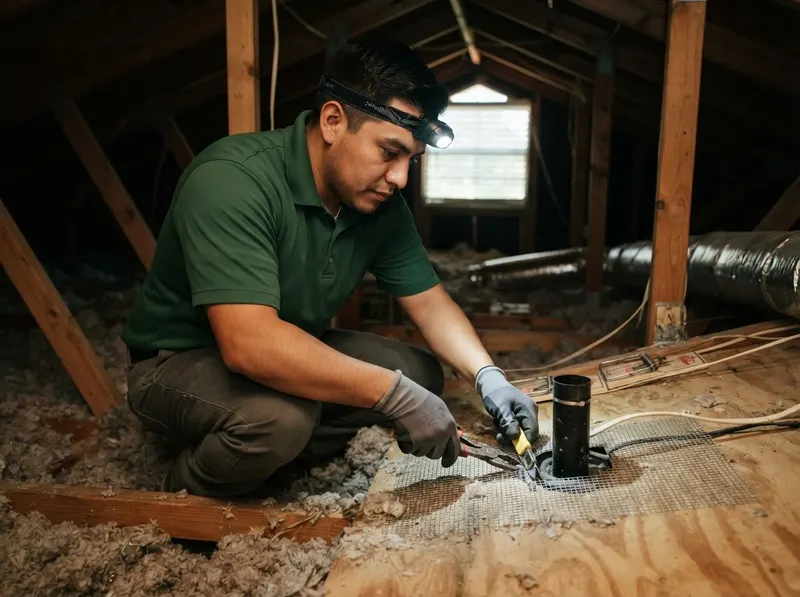
Structural shifts in coastal gumbo clay across West University Place, Clear Lake, and Kingwood routinely pull friable trim boards away from roof decks, expanding soffit corners into ready entryways. Mechanical trapping isolates the nesting rodents inside the attic perimeter using non-toxic food attractants like whole pecans and rolled oats. Technicians execute step 1 by conducting a full attic run-line inspection to tally gnaw marks, rub points, and droppings. Step 2 involves staging directional mechanical traps along joists away from central HVAC ductwork. Step 3 seals every perimeter void exceeding 0.25 inches with chew-proof hardware cloth and steel wool backing, securing the living envelope against future seasonal re-entry.
Every job gets a firm, written price after a free on-site visit.
Tell us about your roof rat attic exclusion and mechanical trapping job in Houston and we'll send a clear, written quote, usually the same day.
 Bayou Hawk Pest Control